
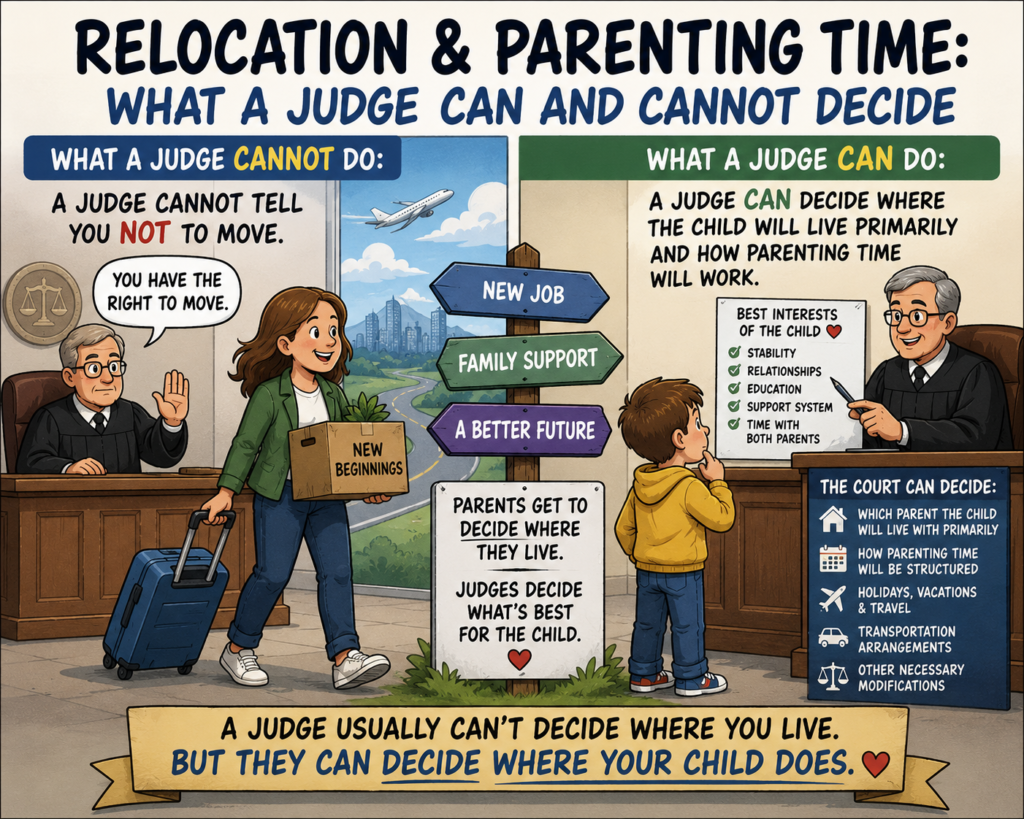
One of the most common questions parents ask during and after a divorce is:
“Can a judge stop me from moving?”
The short answer is usually no.
In most situations, a judge cannot order an adult to remain in a particular city, county, or state. Adults generally have the freedom to decide where they live, where they work, and where they build their lives.
But when children are involved, the analysis becomes more complicated.
While a judge typically cannot decide where a parent lives, a judge can decide where a child lives.
That distinction is important—and it often changes everything.
The Right to Move
People relocate for all kinds of reasons.
A new job opportunity. A remarriage. A desire to be closer to family. Better housing. Lower costs of living. Educational opportunities.
Courts generally recognize that parents have legitimate reasons for wanting to relocate.
The law does not require a parent to remain in a particular location simply because they share a child with someone else.
If a parent wants to move, they are generally free to do so.
The real question is not whether the parent can move.
The real question is what happens to the parenting plan if they do.
What the Court Can Decide
Although a court usually cannot prevent a parent from relocating, it can determine what arrangement serves the child’s best interests after the move.
For example, a judge may decide:
- Which parent will be the child’s primary residential parent.
- Whether the child should relocate with the moving parent.
- How parenting time will be structured after the move.
- How holidays, school breaks, and summer parenting time will be allocated.
- How transportation responsibilities will be divided.
- Whether decision-making provisions should be modified.
In other words, the court’s authority focuses on the child—not the parent’s ability to relocate.
A Common Misunderstanding
Many parents believe they have only two options:
- Stay where they are.
- Move and automatically take the child with them.
In reality, there is often a third possibility.
The parent may choose to relocate, while the child remains primarily with the other parent.
That does not mean the moving parent has done anything wrong.
It simply reflects the court’s responsibility to determine which arrangement best serves the child’s needs under the new circumstances.
The Court’s Focus Is the Child
Relocation cases are rarely about whether a parent’s reason for moving is “good enough.”
Instead, courts typically focus on practical questions such as:
- How will the move affect the child’s relationship with each parent?
- How involved is each parent in the child’s life?
- What impact will the move have on the child’s education, activities, and support systems?
- Can meaningful parenting time still occur after the relocation?
- How will travel affect the child?
- What arrangement is most likely to promote stability and healthy relationships?
These cases are often among the most fact-intensive disputes family courts handle because there is rarely a perfect solution.
There Are No Perfect Outcomes
One of the hardest realities in relocation cases is that someone usually loses something.
The moving parent may lose day-to-day contact with the child.
The non-moving parent may lose frequent parenting time if the child relocates.
The child may lose proximity to one parent regardless of the outcome.
Courts cannot create additional hours in the day or eliminate geographic distance.
Their role is to determine which arrangement best supports the child’s overall well-being under the circumstances presented.
Relocation Is Not About Permission
Perhaps the most important thing for parents to understand is that relocation cases are not typically about asking a judge for permission to move.
Adults remain free to make decisions about where they live.
Instead, relocation cases are about determining how that decision affects the child and what parenting arrangement will best serve the child’s interests going forward.
The court generally cannot tell a parent:
“You are not allowed to move.”
But the court can say:
“If you move, the child’s primary residence will remain here.”
That distinction is often the most important—and least understood—aspect of relocation cases.
The Bottom Line
Parents have the right to make decisions about their own lives. Courts have the responsibility to protect the best interests of children.
When those two principles intersect, relocation cases arise.
The question is rarely whether a parent can move.
The question is whether the child should move too.
Understanding that distinction can help parents approach relocation disputes with realistic expectations, better information, and a clearer understanding of what a judge can—and cannot—decide.