
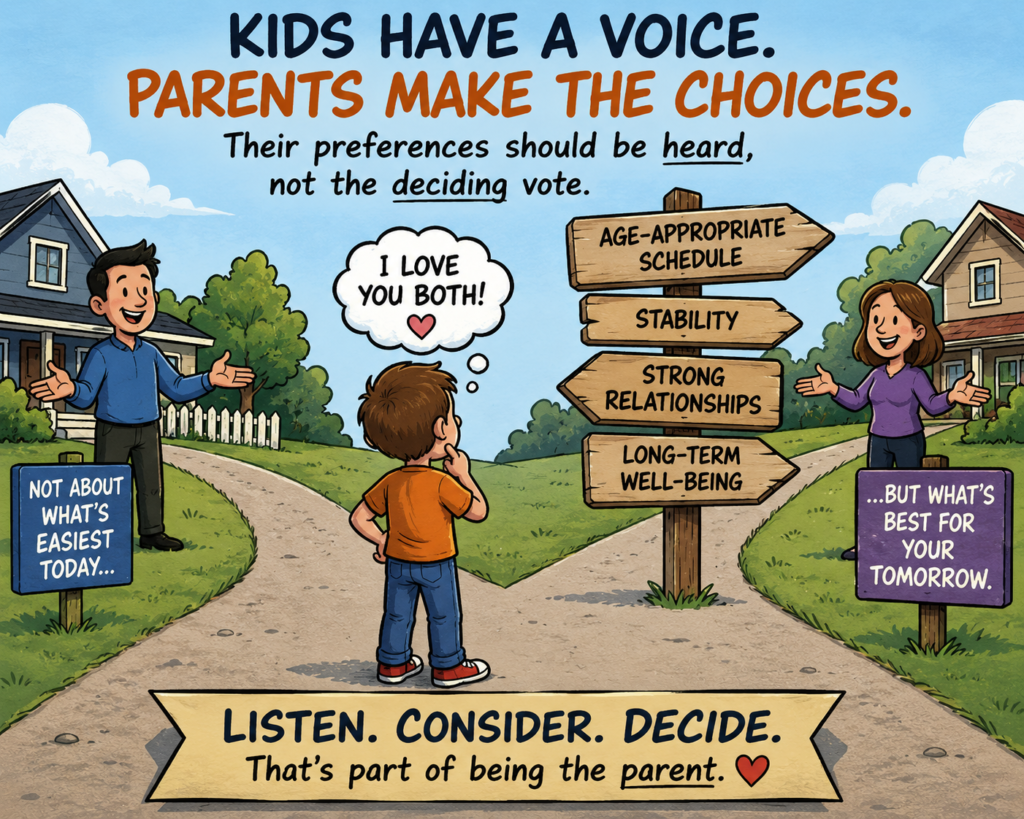
One of the most common statements heard in family law cases is:
“My child is old enough to decide where they want to live.”
While children’s preferences can absolutely be important, there is a significant difference between considering a child’s wishes and allowing a child to dictate a parenting time arrangement.
That distinction matters.
Children’s Voices Matter
Children are not passive observers in their own lives. They experience the realities of divorce, separation, and family conflict every day.
As children mature, they often develop thoughtful opinions about schedules, activities, friendships, school commitments, and family relationships. It would be unreasonable—and often harmful—to ignore those perspectives entirely.
For that reason, courts frequently consider a child’s wishes as one factor among many when determining what arrangement serves the child’s best interests.
But that does not mean children get the final say.
Why Courts Are Reluctant to Let Children Decide
The reason is simple: parenting decisions are adult responsibilities.
Most adults would never allow a child to decide whether to attend school, receive medical treatment, wear a seatbelt, brush their teeth, or eat ice cream for every meal. Those decisions remain the responsibility of parents because children are still developing the judgment, experience, and emotional maturity necessary to make major life decisions.
The same principle applies to parenting time.
Children often make decisions based on what feels easiest, most comfortable, or most immediately rewarding. That is not a criticism—it is a normal part of childhood.
A teenager may prefer the household with fewer rules, later curfews, less homework supervision, or greater access to electronics. A younger child may resist parenting time because transitions are difficult or because they miss the parent they just left.
Those preferences may be genuine, but they do not necessarily reflect what is best for the child’s long-term development.
The Weight of an Adult Decision
When adults ask children to choose between parents, they often underestimate the burden that choice creates.
Most children love both parents.
Even when family conflict exists, children frequently feel loyalty to both households. Asking them to decide where they will spend their time can create anxiety, guilt, and emotional pressure that no child should have to carry.
Many children worry that choosing one parent will hurt the other parent’s feelings. Others fear disappointing a parent or damaging a relationship.
The result is that children are often placed in an impossible position: making a decision they should never have been asked to make in the first place.
Preferences Are Information, Not Instructions
A child’s wishes can provide valuable information.
If a child consistently resists spending time with a parent, adults should seek to understand why.
Is the schedule no longer age-appropriate?
Is the child struggling with transitions?
Are there unresolved conflicts?
Are extracurricular activities creating logistical challenges?
Is there a legitimate concern that needs attention?
These questions deserve thoughtful exploration.
But a child’s preference should be viewed as information to be considered—not as an instruction that automatically determines the outcome.
What Children Need Most
Children need loving adults who are willing to make difficult decisions on their behalf.
They need parents who can distinguish between a child’s temporary desires and their long-term needs.
They need adults who are willing to listen carefully, take concerns seriously, and make thoughtful decisions—even when those decisions are not immediately popular.
Most importantly, children need the freedom to be children.
They should not be expected to choose sides. They should not be responsible for determining parenting schedules. And they should not carry the emotional burden of deciding which parent “wins.”
That responsibility belongs to the adults.
The Goal Is Not to Silence Children
Considering a child’s preferences and allowing a child to dictate parenting time are not the same thing.
A healthy approach does not silence children, nor does it place them in charge.
Instead, it strikes a balance: listening to children, understanding their experiences, and thoughtfully considering their wishes while recognizing that adults remain responsible for making decisions that serve the child’s best interests.
Children deserve a voice.
They do not deserve the weight of being the decision-maker.