
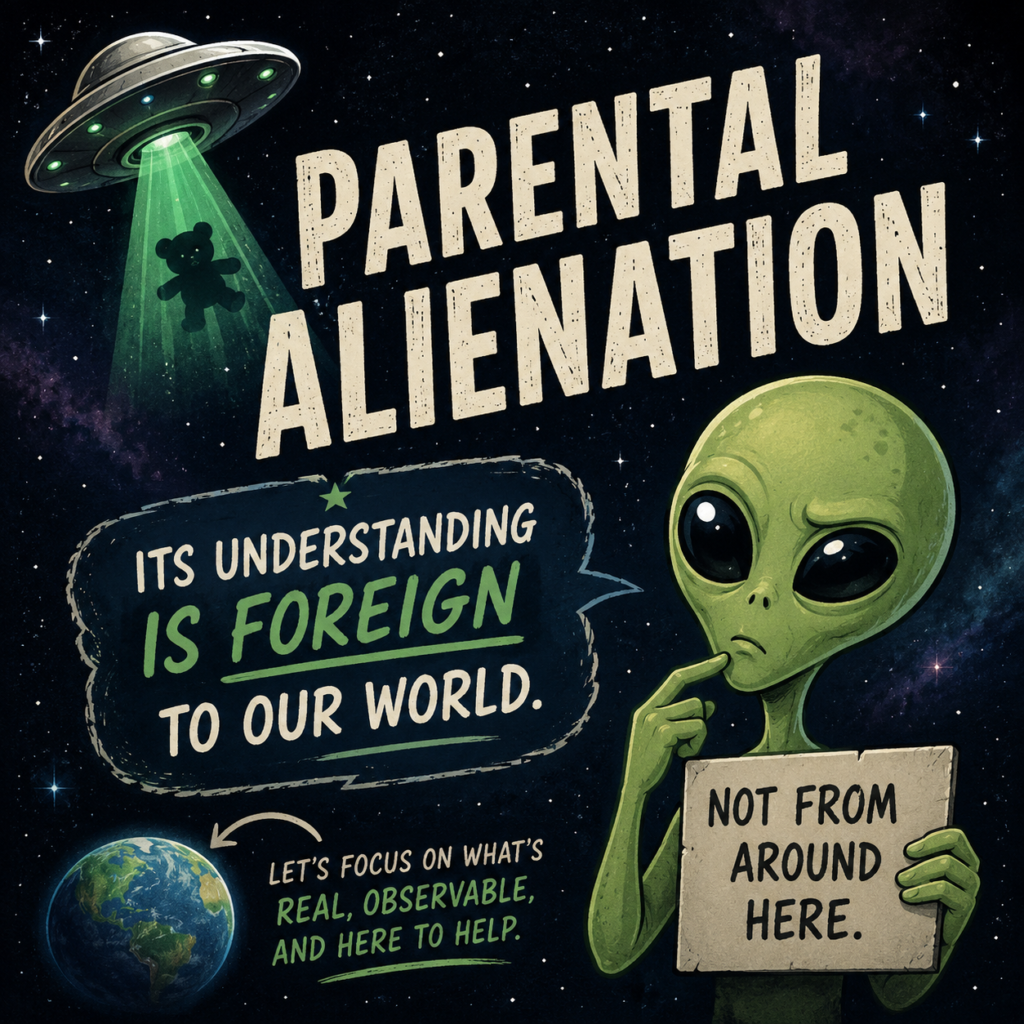
If you’ve spent any time in family court, you’ve probably heard the term parental alienation.
It appears in pleadings, evaluations, social media discussions, therapy recommendations, and courtroom arguments. In some cases, it is used to describe a very real concern: a child becoming resistant to or rejecting a parent due to the influence of another parent. In others, it has become a catch-all explanation for nearly any parent-child relationship problem following separation or divorce.
The problem is that the term has become so broad, so emotionally charged, and so inconsistently applied that it often creates more heat than light.
In many ways, “parental alienation” has become the family law equivalent of the word “narcissist.” The term may describe a real phenomenon, but it is frequently used as a shortcut—a label that replaces careful analysis of what is actually happening within a family.
And when we focus on labels instead of behaviors, children can get lost in the process.
The Trouble with Buzzwords
Family law cases are rarely simple.
Children may resist contact with a parent for any number of reasons. Sometimes those reasons stem from a parent’s intentional efforts to undermine the relationship. Sometimes they arise from loyalty conflicts, high parental conflict, anxiety, developmental challenges, communication breakdowns, or a child’s attempt to cope with circumstances they do not fully understand.
Yet all of these vastly different situations are often described using the same word: alienation.
The result is that meaningful conversations about the underlying issues are replaced by arguments about whether a label applies.
Once the word enters a case, parties often stop discussing specific conduct and begin debating diagnoses. The focus shifts from evidence to narratives. Instead of asking, “What is happening to this child?” the conversation becomes, “Is this alienation?”
That is rarely the most useful question.
The Better Question
Rather than asking whether alienation exists, courts, attorneys, evaluators, and parents should ask:
What specific behaviors are affecting this child’s relationship with a parent?
That question invites evidence instead of assumptions.
It encourages people to examine observable facts, such as:
- Is one parent interfering with communication?
- Is important information being withheld?
- Are parenting time exchanges being disrupted?
- Is a child being placed in the middle of adult conflict?
- Are negative messages about a parent reaching the child?
- Is a parent encouraging a child to make decisions that should remain between adults?
- Are there legitimate concerns that explain the child’s resistance?
These questions focus attention where it belongs: on the child’s lived experience.
More Accurate Terms for More Accurate Analysis
When we move away from broad labels, we often discover language that better describes the actual problem.
Gatekeeping
One increasingly useful term is gatekeeping.
Gatekeeping occurs when one parent controls access to information, activities, decision-making, communication, or opportunities for involvement.
A parent who consistently fails to share medical information, excludes the other parent from school events, or creates unnecessary barriers to communication may be engaging in gatekeeping behavior.
Unlike “alienation,” gatekeeping describes a specific, observable pattern of conduct.
Relationship Interference
Another useful term is relationship interference.
This phrase focuses on the impact of a parent’s actions rather than attempting to diagnose motivations or psychological conditions.
Repeatedly obstructing parenting time, discouraging contact, or creating obstacles to a child’s relationship with the other parent can all constitute forms of relationship interference.
The focus remains on what happened—not what someone chooses to call it.
Loyalty Conflicts
Children are often far more perceptive than adults realize.
Many children quickly learn which topics, feelings, or relationships may upset a parent. They may begin concealing positive experiences with one parent to avoid hurting the other. They may feel guilty for enjoying time with both households.
These are known as loyalty conflicts.
Importantly, loyalty conflicts can develop even without intentional manipulation. Children naturally seek security and approval from the adults they depend upon. In high-conflict families, they often carry emotional burdens that no child should have to manage.
Family Systems Dynamics
Sometimes the issue is not one parent’s conduct at all.
Family relationships operate within larger systems. Anxiety, conflict, transitions, grief, communication patterns, and developmental changes can all affect a child’s willingness or ability to engage with a parent.
Viewing these situations through a family systems lens often provides a more complete and nuanced understanding than a single label ever could.
Why Precision Matters
Words matter because they shape the way we understand problems and the solutions we pursue.
When we use broad, emotionally charged terminology, we risk oversimplifying complex family dynamics. We may overlook important contributing factors. We may miss opportunities for intervention. We may unintentionally encourage parties to defend positions rather than solve problems.
By contrast, focusing on specific behaviors allows professionals to identify concrete concerns and craft meaningful remedies.
If a parent is withholding information, the solution may involve improved communication protocols.
If a child is experiencing loyalty conflicts, therapy may be appropriate.
If parenting time is repeatedly being undermined, court intervention may be necessary.
Specific problems are far easier to address than broad labels.
Keeping the Focus on Children
At its core, family law is not about winning arguments over terminology.
It is about helping children maintain healthy relationships with safe, loving adults whenever possible.
Whether a case involves gatekeeping, relationship interference, loyalty conflicts, communication failures, high parental conflict, or something else entirely, the ultimate question remains the same:
What is helping—or harming—this child’s relationship with the people who love them?
That question is more important than any label.
And perhaps it is time for family law professionals to spend less energy debating whether a family fits within the framework of “parental alienation” and more energy identifying the specific behaviors and circumstances that affect children every day.
Because children deserve solutions—not buzzwords.